(2)
With an active Phase 3 trial, FDA Fast Track status, and a clear regulatory blueprint targeting early commercial entry by 2026, the story is no longer about potential... It’s about execution. This is a late-stage oncology platform hitting its stride with surgical precision, offering a setup that savvy participants are using to position for
a potential move of over 450% to meet analyst expectations.
Deciphering the Valuation Gap: The $12.14 Target (1)(2)(7)(8)
The most compelling aspect of MAIA right now is a massive mathematical disconnect.
The consensus view among research analysts specializing in oncology development sits at $12.14. This isn't a blue-sky projection;
it is a professional valuation of a company currently running a pivotal Phase 3 trial in third-line NSCLC.
This gap persists despite the fact that MAIA is utilizing Bayesian statistical modeling that indicates a high probability of technical success. This confidence stems from Phase 2 data that didn't just beat the standard of care, it tripled survival outcomes.
When a valuation lag this significant occurs during registrational development, it often
represents compressed upside rather than market noise.
Strategic Partnerships: Institutional Validation (5)(6)(7)(8)(9)
MAIA is not navigating this path alone. The company has secured critical clinical supply and master agreements with global pharmaceutical giants, including Roche and BeOne Medicines.
These alliances allow MAIA to test its lead candidate alongside established
checkpoint inhibitors without taking on the associated development costs or risks.
Large-cap pharmaceutical entities are notoriously selective.
Their decision to collaborate serves as a significant form of due diligence, reflecting deep confidence in MAIA's mechanism of action and its ability to enhance existing immunotherapies.
Proprietary Science: Eliminating Cancer’s "Immortality" (5)(6)(7)(8)(9)
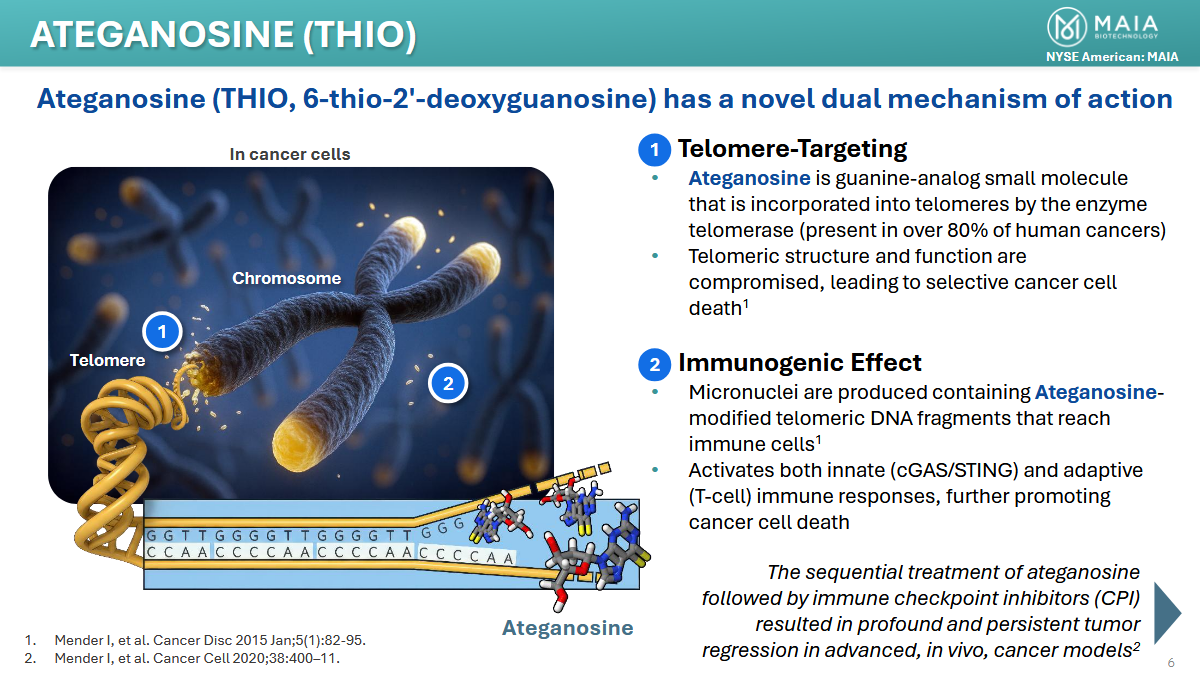
At the core of this momentum is THIO (ateganosine), a first-in-class molecule attacking cancer at its foundation. Cancer cells rely on the enzyme telomerase to maintain telomeres—the protective caps on chromosomes—essentially making the cells "immortal."
Ateganosine is currently the only direct telomere-targeting agent in clinical development worldwide. It works through a dual
mechanism:
- Selective Death: It incorporates into telomeres, causing cancer cell death.
+1 - Immune Activation: It triggers an immune response that turns "cold" tumors "hot," enabling the body’s own defenses to join the fight.